Where facial paralysis is thought to be caused by an infection, various medical treatments may be prescribed.
This information is intended to explain how and when these treatments may be used. You should always seek advice from your GP before taking any medication.
Steroids
Relevant to: Bell’s palsy, Ramsay Hunt syndrome.
A steroid called Prednisolone is commonly used to treat patients with Bell’s palsy. This should be commenced within 72 hours of the symptoms appearing (1) and works by helping to reduce inflammation around the facial nerve, reducing damage and hence severity of symptoms. There is limited evidence to suggest that there is any benefit in taking steroids beyond the 72-hour time window and certainly not beyond 7 days. The sooner steroids are started the more effective they are.
People with Bell’s palsy are usually advised to take prednisolone tablets for 10 days.
It is important to remember that starting steroids within 72 hours of onset of symptoms will not guarantee a full recovery. However, this treatment will give you the best possible chance of making a full recovery or minimising the degree of palsy and should be taken if prescribed by your clinician.
Where a diagnosis of Ramsay Hunt syndrome, facial palsy caused by shingles, is suspected (classically facial palsy with pain and often a rash around the ear or mouth), steroids can be prescribed in addition to antivirals (see below). Evidence suggests ‘prompt combination treatment, within 72 hours, with high-dose oral corticosteroids, e.g. prednisolone, and antivirals are recommended in all patients’. (2) While the effectiveness of the use of steroids for treatment of Ramsay Hunt syndrome is not proven it is unlikely to do harm and can potentially help with pain and improve prognosis.
Frequently asked:
Question: What are the commonest side-effects with short-term steroids?
Answer: Steroids are only prescribed for a short period in facial palsy, usually about 10-14 days. Consequently, the commonest side-effects are increased appetite, mood changes and difficulty sleeping. The chronic, more serious side effects associated with steroids are unlikely given the short duration although it is extremely important to monitor blood glucose in diabetics
Question: Are steroids safe to take when I have another health condition?
Answer: You should always tell your health care provider if you have another health condition when a steroid prescription is being considered. Examples of conditions that might be affected by the steroids are diabetes, high blood pressure, stomach ulcers and mood or psychiatric disorders. Your clinician will then discuss the pros and cons of steroid treatment with you. You may need additional monitoring while taking steroids e.g. glucose monitoring in diabetes.
Bell’s palsy is commoner in pregnancy. Obstetricians generally recommend that steroids can be used safely in pregnancy. Clearly a discussion with the Obstetrician to discuss the pros and cons is necessary.
Question: What time of day should I take steroids?
Answer: It is best to take steroids with breakfast or lunch (not on an empty stomach). If taken later in the day they may cause insomnia. The timing is recommended to align with the body’s natural production of steroids.
Question: Are steroids safe for children to take?
Answer: Steroids are safe in children in short courses. There is however less evidence for the effectiveness of steroids in the outcome of Bell’s palsy in children. This is due to the generally good outcome in children but also to the lack of clinical trials. The decision to prescribe steroids will therefore depend on the clinical picture and your clinician’s assessment of risk vs benefit.
Caution: You should always seek advice from the health professional in charge of your child’s care before giving them any medication as they will know your child’s full medical history.
Antivirals
Relevant to: Ramsay Hunt syndrome. Bell’s palsy, if uncertainty as to whether could be Ramsay Hunt syndrome without a rash.
Antivirals are used to treat viral infections.
Ramsay Hunt syndrome is caused by shingles. Shingles is the reactivation of the chickenpox virus (varicella zoster virus (VZV)) from within. Where Ramsay Hunt syndrome is suspected, antiviral medications are usually prescribed for 7 to 10 days, in combination with steroids. Examples of antivirals are Valacyclovir (also known as Valtrex), Aciclovir (previously known as Acyclovir, also known as Zovirax) or Famciclovir (also known as Famvir). This medication may reduce the severity and duration of Ramsay Hunt syndrome if given promptly after onset of symptoms, within 72 hours.
The prognosis for recovery from Ramsay Hunt syndrome is worse than with Bell’s palsy so prompt diagnosis and treatment is particular important.
Antivirals may also be recommended in cases initially diagnosed as Bell’s palsy where there is uncertainty as to whether the facial palsy may in fact be Ramsay Hunt syndrome with no rash (Zoster Sine Herpete) or complex symptoms such as increased pain, vertigo or deafness suggest there is a possibility of an evolving Ramsay Hunt syndrome.
Antiviral drugs have few significant side-effects so it is reasonable to consider prescribing them in addition to steroids, where uncertainty exists, as this represents a low risk strategy.
Question: Are antivirals safe to take?
Answer: Yes, antivirals are generally safe to take with few significant side-effects.
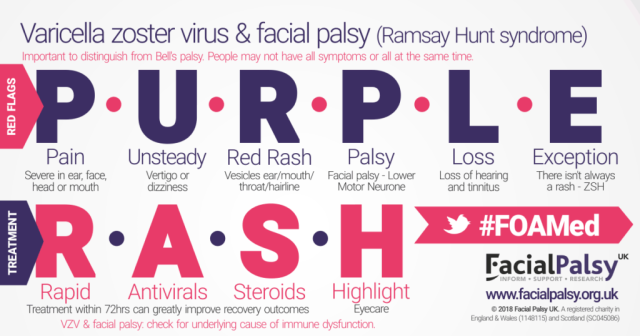
Mnemonic – spot the warning signs of Ramsay Hunt syndrome
Antibiotics
Relevant to: Lyme disease.
Lyme disease is a potential cause of facial palsy and the commonest cause of acute onset facial palsy in children. When a patient is diagnosed with Lyme disease, they are treated with antibiotics because this is a bacterial infection.
Doxycycline, amoxycillin or azithromycin are the three front line drugs advised for 17-21 days depending on drug. (3)
Patients should discuss the side effects of medications with their prescribing clinician and ensure they read the medicine information leaflet.
Sources:
1: NICE: Management of Bell’s palsy
2: BMJ Best Practice – Ramsay Hunt syndrome
3: Antibiotics in Lyme disease
FPUK Associated Articles:
Last reviewed: 20-01-2026 || Next review due: 20-01-2028