
This information is for those with a newly acquired facial palsy where some or a full recovery may be expected, for example those diagnosed with Bell’s palsy or Ramsay Hunt syndrome. In these cases facial palsy is caused by inflammation around the facial nerve that needs time to settle down. For those with facial palsy that does not follow the same recovery path, such as congenital causes or where the nerve has been cut, there is still help available so please contact our support team on support@facialpalsy.org.uk if you require more information.
When some recovery is expected
Keeping a photographic diary of your recovery can help you and the clinicians involved in your care. In the early days of developing a facial palsy, getting the correct diagnosis or finding out the cause is the first goal. Once the diagnosis is confirmed and the treatment commences, then you must wait for spontaneous recovery to take place.
Bell’s palsy has a good prognosis with the right treatment. Improvement occurs within 3 weeks in 70% of people, the remaining 30% may take longer to recover. It is a little less for those diagnosed with Ramsay Hunt syndrome (approximately 60–65%). Regardless of the cause, the early weeks and months of living with facial palsy can be a difficult and anxious time because you do not know how quickly you are going to recover.
If it has taken more than 3- 4 months to recover it is very unlikely that recovery will be complete and there will be residual symptoms of high muscle tone and synkinesis to a greater or lesser extent especially if a person hasn’t had access to the correct advice.
The sooner you start to see signs of recovery, the more likely you are to make a full recovery. Recovery is dependent on the type of nerve injury. Read more about facial nerve recovery and facial nerve injury.
Do’s and Don’ts for the newly diagnosed and those experiencing a delayed recovery
Do:
- Watch the video ‘Understanding Facial Palsy’
- Follow all the guidance on this link about management of the face when it is floppy including advice on eye care, eye taping, facial massage and stretches for the unaffected/strong side.
- Rest and relax. Try listening to the audio and watching the video on these links to help with relaxation which should be done little and often throughout the day.
- Take some baseline photographs as soon as you get the opportunity to map your progress. It is difficult to monitor progress when you see yourself all the time. See the section below on ‘photographs’, as there is some important information to help you maximise the benefits of a photo diary and minimise any bad habits.
Don’t:
- Keep going to the mirror and checking out your face.
- If you do keep checking for movement in the mirror don’t pull faces or make forceful/effortful facial expressions. This will just compound the asymmetry causing your uninjured side to become stronger and more dominant making the asymmetry more obvious potentially increasing the brain’s neglect of the weak side. What this means is if the paralysed or weak side of your face does not move the brain will start to ignore it especially if the unaffected side is overactive and being doubly expressive to compensate for the lack of movement on the affected side.
- Often people are given incorrect advice. The two most incorrect pieces of advice are about chewing gum and scrunching the affected eye closed. Please do not chew gum and do not try and scrunch your eyes closed in the hopes of strengthening weak muscles. This is not a situation where repetition of movement and lots of effort will help. The facial nerve is compressed so messages from the brain to the facial muscles are blocked. The nerve is unable to send messages beyond the compression or blockage. Electrical messages from the brain to make facial expressions never reach the target muscles. It is like trying to switch on a lamp which isn’t plugged into the wall socket. The best thing you can do is rest, look after your eye, carry out the facial massage, and try to relax.
Photographs
Photographing yourself may be right at the bottom of the list of things you want to do. If you don’t feel up to it, ask a trusted person/family member to take them for you. Try not to be judgmental about the way you look. The photos are an aid to monitoring your progress which you can share with your clinician so they can understand the details of your recovery. Sometimes people don’t think they are improving because they see themselves every day. Photographs are a way of making objective observations about how well and how quickly you are recovering. Recovery may be very slow for those with more prolonged compression of the nerve, but this does not mean that you won’t go on to make good progress. First signs of recovery may not appear for many months. If you haven’t noticed any recovery within 3 months, you should go back to your GP and ask for a referral to a specialist facial palsy service. For further information please follow the link below:
Approaching your GP for more help
Setting up
- Ensure you have a plain background behind you. It can be light or dark, but it should be the same background each time you photograph yourself.
- Ensure the light is behind the camera and is very bright.
- Make sure you aren’t in shadow.
- Keep your hair away from your face to prevent any masking. Perhaps tie it back and/or use a hairband to keep the brow clear.
- You just need your head and neck in the viewfinder so you should be quite close to the camera.
- Face the camera full on which means you shouldn’t turn your head at all. This can be quite challenging, as you may be turning slightly away from people to hide the weak side of your face.
Expressions to capture
When you photograph yourself doing the expressions below, please don’t use force or effort. Just think ‘gentle movements’ which are clear but not exaggerated. Remember, our facial muscles are delicate structures and very little effort is required for natural facial expression.
- Relaxed/neutral face
- Gentle eye closure
- Gentle closed-mouth smile
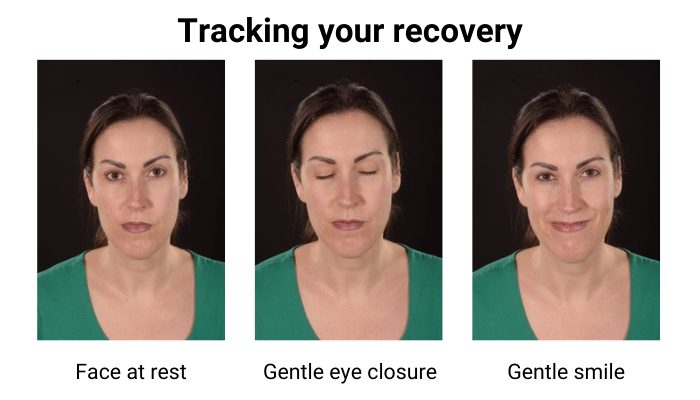
It is very useful to take a 5-second video of yourself blinking gently and slowly. Play this back in slow-motion mode to see how well your eyelid is moving when you try to blink.
Check that you are happy with the quality and clarity of the photographs and if necessary repeat the sequence only keeping the ones that are most realistic and with the greatest clarity.
Frequency
Newly diagnosed?
If you have just been diagnosed with facial palsy, then repeat the photograph sequence above every five days for the first three weeks. Try and make sure all the conditions are the same especially the lighting, background, and your hair. Avoid going to the mirror to keep checking for recovery to prevent yourself from pulling awkward faces in an attempt to get some movement. Just allow the spontaneous recovery to happen without trying to intervene – you will just create more problems. Less is more at this stage.
Delayed recovery?
If you haven’t made a good or full recovery within the first three weeks, then your recovery is delayed. Once again this is an anxious time – a waiting game. Don’t put yourself under pressure. Remember if the nerve can recover and the body heal itself it will. Don’t interfere. Try and stay calm. Repeat the photographic sequence every two weeks to monitor your progress. Don’t feel down if you don’t see any changes. Many people wait several months before recovery begins. It doesn’t mean you won’t make a good recovery so do try and follow the advice given. Even at this stage, the advice is to continue with your eye care, carry out your relaxation exercises, and continue with your facial massage. Be gentle with your face. Do not attempt any movement exercises until at least 12 weeks following the onset of your symptoms. You must not start any movement exercise unless you have fulfilled the criteria given on the link below:
Link to management of paresis videos
Preparing for an appointment with a specialist?
If you are preparing for an appointment with a specialist, there is more information on the page linked below about further photographs you can take. We do urge caution against doing anything other than gentle facial expressions during the first few weeks though.
Preparing for an appointment with a specialist
Last reviewed: 19-08-2025 || Next review due: 01-09-2026