

In November 2006, I was working as the Local Services Manager for a housing charity that offered housing support services to vulnerable people from all kinds of client groups. At the time, we were fighting for funding and going through an internal restructure, so it was a very stressful time for the entire staff team.
On the 6th Nov. I left work early because I felt really ill. I actually joked with some of the staff that I thought I had meningitis because of an unusual pain on the left side of my face and the back of my neck, but couldn’t have it because I didn’t have any aversion to ‘bright lights’.
I took some pain relief and went to bed early. That was my last day with my familiar, loved, and lived-in face.
I woke up the next morning and said to my partner at the time that my eye felt really sore. He looked at me and said, “Don’t worry about your eye, it’s the rest of your face I’d be worried about”. I went straight to the bathroom and looked in the mirror. The left side of my face had completely dropped. It looked hideous, and it simply wouldn’t respond to me trying to move it. I tried to smile, to shut my eye, to move any part of it, but it was frozen. As I stood looking at this alien face, my partner walked into the bathroom and stood behind me. He looked into the mirror and said, “Well, it’s a good job you already have a partner because you won’t get another looking like that”. I was 50 years old but those words stung like I was a small child.
On calling the doctors surgery I was advised to go to the hospital, as they were concerned that I may have had a stroke. As the morning progressed and the tests to indicate if it was a stroke or not were ticked off, I realised that I had a strange metallic taste in my mouth, and my tongue wouldn’t move properly, which made me sound like I had been drinking as I was slurring my words because my mouth wouldn’t move like it always had done. My eye became more and more painful, and I had to close it by pressing my eyelid shut with my fingers. My left ear was hurting and sounds were painfully amplified. Once it had been established that I hadn’t had a stroke, I was allowed a drink. I tried to have a cup of tea but as the weak hospital brew spilled down my chin and neck and onto my clothes, I realised I couldn’t drink anymore. I think it was at this point I started crying, which only made me find out I had also lost the tears in my left eye.
The diagnosis was Bell’s Palsy, which I had never heard of, and I can’t say that there was much information other than it should get better within 6 weeks. I was sent away with a bunch of steroids and antiviral medication, a wondrous tube of eye gel, and the promise of an appointment for the eye hospital and the neurology clinic to be sent in the post.
Over the next few days, I found that I was quite sensitive to the preservatives in the tube of eye gel, as my eye turned red and swollen. My lovely GP at that time prescribed little individual single dose phials of Celluvisc 1% for day time use and a much thicker gel for night-time because my eye didn’t shut at all. I taped the offending eyelids shut at first, but my top eyelid would roll itself up, and I often had to wake up to add more drops. (My eye still doesn’t stay closed when I’m asleep 16 years later, but I can blink and I still close it with my fingers if I need to close it for a while, like when I’m having my fringe cut or when it’s tired and sore.) I also had to tape my eye shut and wear a big pad on it to stop the eyelid rolling when I went outside because of the wind and cold. Also, as I had no blink reflex I often had bits of flying debris stuck on my eyeball or I’d poke myself in the eye without thinking.
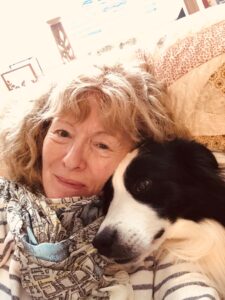
As the days went by it felt like the left side of my face had been hit with a cricket bat. It was so painful, but remained dead to me. When I looked in the mirror I was surprised that my face wasn’t bruised black and blue, it was just pale, frozen, and ugly. My inner ear was also paralysed and was so sensitive I used ear plugs to try to help keep noises at a bearable level.
I couldn’t go to work because I was exhausted, and due to the lack of movement around my eye, I found I couldn’t walk straight or consider driving. I couldn’t focus on my computer or concentrate on anything for more than a few minutes. I clung onto the ‘it will get better within six weeks’, but as I inched closer to the magic week six I had to reassess and face up to the fact that this wasn’t going away just yet.
When I had my first appointment at the neurology clinic at (I think) around 4 or 5 weeks in, it became apparent that there was little that could be done. An option of stitching my eyelids together on my left eye was discussed but I didn’t want to have it done and that was about it. There was no support around the massive changes to my looks or how to deal with the emotional side of BP. I had the appointment at the eye clinic and as I was really conscientious about my eye care, there wasn’t anything they could do other than offer to monitor the situation.
As time went on, I started to have a little movement around my eye, and then I started to get very noticeable pulses of movement in my cheek, but they were involuntary and uncontrollable. Around this time a colleague found a website that changed my perspective, BellsPalsy.org.uk. I will be eternally grateful to her and the organisation. I devoured their information, I read all their FAQs, I joined their forum, and finally had information and support from fellow sufferers. I’d already found that wearing swimming goggles in the shower worked a treat, the benefits of drinking straws, ear plugs, sunglasses and warm wheatie bags, but here was information around Bell’s Palsy I had never been given. NOT to try to force movement, NOT to have deep massage or acupuncture, to be very wary of botox too early on, etc., and the best of all… why my face twitched and contorted uncontrollably and why I was growing a crater in my chin!
I also realised that I was in the 20% of BP sufferers that go on to have long term issues, and I had to accept that I wasn’t going to wake up with my face working smoothly again anytime soon. There seemed to be a popular idea at the time that improvement could happen up to around 2.5 years, but then this would stop. However, I have experienced changes throughout the past 16 years and continue to do so. It might only be a little more movement in my top lip or a pause in the regular little ‘electric’ shocks in my bottom lip, but it’s progress!
Despite the little progress that was yet to come, synkinesis and hypertonicity were the bane of my life for the next 3 years.

I slowly started to get used to my wonky face and went out with my family or friends before I could drive and be independent again. My partner’s sister-in-law said I was ‘brave’ to go out of the house because she would never be seen in public looking like I did. I found that strangers would often treat me like they thought I had a Learning Disability. They would either speak really slowly or not get into conversation with me at all, or quite openly move away from me. When I took my mum shopping she would sometimes loudly excuse me, saying, “It’s ok, she’s got Bell’s Palsy”. I like to think she thought she was helping me.
At work, I often noticed that during phone calls in the late afternoon when my face was tired, people would ask if I was ok or not. I think this was because I slurred my words more, and I started offering the explanation before they got the wrong idea. I enjoyed my job, and although I would still attend conferences, I no longer wanted to give big presentations around the then Government’s Supporting People Housing Initiative because public speaking wasn’t just embarrassing now, it was difficult to actually say some words. Also, I wasn’t sure if I was dribbling as I spoke or if I would be hit with my twitching and contortions, or worse still, my crude ‘Elvis sneer’ that occasionally stayed long enough to need a small dose of medication to relax it.
In the summer of 2009 it was actually a relief to have my second episode of BP. I knew the signs and went straight to my GP for steroids, antivirals, and anti-inflammatories. Another referral to the neurologist was requested and I was offered botox to try to control the residuals. Luckily, I refused at that time because a few weeks later I began to get small voluntary movements back, and this continued until I could actually drink from a very thin cup without a straw without too much spillage! How I wish my dad could have seen me achieve this, since he was the first person I called when I first flickered my eyelid 3 years before, but sadly he lost his battle with cancer not long afterwards. He is sorely missed. Also, if I had accepted the botox, only the left side of my face would have been free of charge. But at that time, I would have had to pay for the right side to be done to look similar, as it was considered to be cosmetic.
Life carried on and around 2013/14 I left my partner and changed jobs. I didn’t let BP stop me from doing anything, and the biggest issue for me then and now, was the fact that I could not smile in photos. The tell-tail wonky smile of facial palsy is a nightmare for me. I simply cannot accept that that is what I look like in photos.
My family and long-term friends remembered me before BP but accepted me after the change. Those that didn’t were no longer part of my life, and the people I met after 2006 only knew me with BP so I just got on with it. I went to my eye care appointments and had some amazing adventures. I lived and worked on a sheep farm for a few years then moved to my own home in 2016, as well as moving to work in domestic abuse services. I met my husband in 2017 and he has always accepted my quirky looks and smile. He was very supportive when I had further episodes in July and October of 2019. Both of which were not as severe as the previous two episodes and brought a little more movement back to my lower face after the initial paralysis wore off. My chin crater unfortunately grows with each episode as the nerves apparently grow in the wrong places and get tighter. My husband tends to think my eyebrow lift has gotten a little better but I can’t see it myself.
Around October of 2020 I started to feel like another episode was coming on, but this time there were some anomalies with the usual symptoms. The creeping paralysis was worse above my mouth line, and I had a lot of pain in my skin on the left side of my face and around my ear. I experienced weird and distracting noises and a buzzing in my ear. My hearing became extremely sensitive, so much so I had to use two ear plugs to try to dampen noises down. My forehead on the left side of my face felt like I had severe sunburn, and this radiated across my skull. I had had some little blisters on the corner of my mouth, which I thought could have been cold sores, but as I hadn’t had any before I wasn’t sure. I felt exhausted and really low. I went back to my GP who once again prescribed the steroids and antivirals, and this time, I was referred for brain scans to see if there was a reason for the recurrences, like a slow growing tumour or something. I was also referred to a different neurologist who spent a lot of time looking at my BP history and doing a lot of other tests. Thankfully, there was nothing sinister on the scans and after having hearing and eye tests, the consensus of all the consultants was that I had Ramsay Hunt Syndrome this time.
I had further tests at the eye and hearing hospital in April and November of 2021. I was offered an operation to make the canal that my facial nerves travel through under my ear larger to try to prevent further episodes from being so damaging. I decided against having this operation because I was, and remain, really frightened that something will happen during such a complex surgery that would make my condition worse or permanently paralyse my face again. I was discharged at this point but I can be re-referred should I wish in the future.

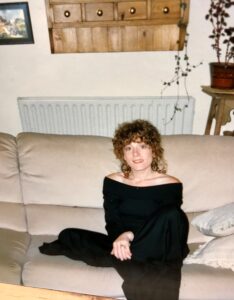
Today I live alongside my face. It’s still not really mine but it’s not as distressing as it was, and I tend to try to ignore it until I notice it in a mirror, on a photo, or in Facetime/Skype. My eye care is of course, vitally important, as is keeping my face warm. I’ve got a rather natty balaclava that makes me look like I’m about to rob a bank, but it’s so cosy when I’m walking our dog.
Most of the time I now live with nerve pain mainly in the top half of my face, around and in my ear, and on a good-sized chunk of my scalp on my affected side. My hairdresser knows he has to be really careful when I’m having my hair done and sometimes I can’t put my hair up because it’s too uncomfortable. I was prescribed medication for the nerve pain but found that, although it was lovely to be relatively pain free, I couldn’t actually function on the dose it required. So, after a few weeks of trying I gave it up as a bad job. I use paracetamol and ibuprofen if I need pain relief now. In fact, I prefer to be aware of the pain so I can monitor it. I do worry when I feel more severe tingles and aches that I will wake up with another full shut down episode, but sometimes this precedes some minor improvements in my facial mobility so it’s a bit of a double-edged sword. Recently, I found that for the first time in 16 years I can eat on both sides of my mouth (yay!), but I had to practise in private as I would lose bits of food or bite my lip or tongue because it was so alien to me. I am happy to say that I can now eat like a boss again. My new ‘friend’ tinnitus is a nuisance and I still turn to see what’s buzzing behind me when it’s been silent for a while……my husband swears it’s a ruse not to listen to him!
Finally, I firmly believe that my sense of humour about my wonkiness, my ticks, and twitches has seen me through this journey, and I much prefer my loved ones to laugh along with me when my eye stubbornly shuts when I’m eating or when my Elvis sneer takes hold, or my drink ends up down my chin. Bell’s Palsy may have brought half my face down at times, but my positive demeanour remains intact.
Disclaimer: Please note that views expressed are person’s own and should not be considered a recommendation of particular medical treatments, therapies or surgeries. We would always advise you seek advice from a health professional with experience in facial palsy who can assess your individual needs.