

Emma was working as a control operator and an on-call firefighter when her symptoms started. After completing an active course at the Fire Service College, she finished a night shift and woke up around 3 p.m. the next day with an unusual sensation on the left side of her face. She struggled to drink from her water bottle and, upon looking in the mirror, realized she could not smile. As time passed, her eye stopped blinking and began watering uncontrollably. Concerned, she contacted 111, who promptly dispatched an ambulance and a local first responder to her home.
‘I was taken to A&E where after waiting nine hours, I was diagnosed with Bell’s palsy, given a course of steroids, told to tape my eye closed at night and that it should correct itself in a few days/weeks.
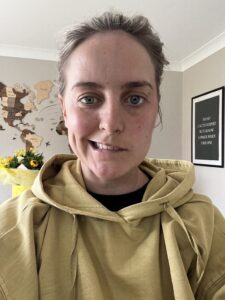
‘That evening the pain in my ear and back of my head started and the pain was excruciating. The following day I went to my local GP to seek some further advice and was told again it was Bell’s palsy and it should resolve by itself “soon enough”. The next few days the pain in my head was so excruciating that I was taken back to A&E and given a cocktail of pain killers. I had researched different causes of Facial Palsy and asked to be prescribed antivirals but was told I didn’t require them.’
Despite assurances from medical professionals, her condition showed no improvement over the next three weeks. Emma also developed hearing sensitivity, which made even whispered conversations painful. Her mother-in-law, who worked in a hospital, consulted a leading Facial Palsy specialist who reviewed Emma’s photos and suspected Ramsay Hunt Syndrome.

Four weeks after her initial diagnosis, Emma was officially diagnosed with Ramsay Hunt Syndrome by the specialist.
‘I saw the consultant four weeks after initially being diagnosed with Bell’s palsy and she did diagnose me with Ramsay Hunt Syndrome, something the local doctors would not do as they had not seen lesions in or around my ear. These would not actually become visible until six months after the onset of Facial Palsy.
‘I began seeing small movements in my cheek after starting acupuncture during month four and the pain and hearing sensitivity eased. The recovery has been the most difficult part, as every day my face feels different, so it’s hard to speak, eat and drink and I have to re-teach myself each morning the best way to not slur, or to not spill my food and drink down myself. I have now developed synkinesis so have involuntary movement and extreme tightness in my cheek which on some days causes my eye to be fully closed/squinted.’

Emma hopes to raise awareness among medical practitioners about the importance of timely antiviral treatment for conditions like Ramsay Hunt Syndrome:
‘I find every day a struggle and the uncertainty of this condition is a scary thought. I am aware that as I didn’t get the antiviral treatment within 72 hours (I got it after four weeks) my chances of a full recovery are less than 30%.’
She firmly believes that prescribing both steroids and antivirals at the outset would have posed no harm but could have significantly improved her chances of recovery. However, despite consulting five different doctors, none were willing to prescribe the necessary medication. As a result, she now faces the possibility of permanent Facial Palsy, a reality she finds deeply frustrating. The initial reassurance that the condition would resolve within weeks was misleading, and she emphasizes the need for better guidance and mental health support for Facial Palsy patients.
‘Before I was diagnosed, I was independent and active, but this condition has taken so much from me. I suffer with fatigue and don’t have the energy or confidence to do all the things I once enjoyed doing like travelling and socialising and this affects me mentally, I feel like Facial Palsy has taken away my personality and identity and I don’t think I will ever get that back.’
Disclaimer: Please note that views expressed are person’s own and should not be considered a recommendation of particular medical treatments, therapies or surgeries. We would always advise you seek advice from a health professional with experience in facial palsy who can assess your individual needs.