
Five years ago 64-year-old Carol was taken ill with Bell’s palsy and spent nearly a week in agony before a doctor realised she had shingles in her ear. It took two more months, and a terrifying dash to hospital by ambulance, before Ramsay Hunt Syndrome (RHS) was finally diagnosed.

Carol before RHS
I am Carol and I’m a carer for my mother who has Alzheimer’s, a part time Social Work Assistant, a wife, a mother, a grandmother. I live near the sea. I love singing (my husband and I run a large choir), gardening, my job, and of course spending time with my mum and the rest of my family.
In April 2014, nearly five years ago, I woke up one night and the side of my face had dropped. I had heard of Bell’s palsy and I knew immediately that I had it. I saw a GP the following morning and was given a course of steroids to take. I told the doctor I had an awful headache and pain in my right ear but this was apparently to be expected with Bell’s and so my ear wasn’t looked at. He signed me off work for two weeks and that was it! I phoned the GP three days later because the pain in my ear and head was so awful. Again I was told to take painkillers – it was ‘to be expected’.
I got through the weekend and then made an appointment to see another GP as the pain wasn’t subsiding, even on the maximum dose of painkillers. I felt ill by this time, which I hadn’t done at the beginning. The GP looked in my ears this time and told me I had shingles in my ear canal. She gave me antiviral medication. It was eight days since the onset of the facial palsy. I still couldn’t go to work. I was taping my eye closed at night which gave some comfort. I rested, alongside trying to get fresh air and exercise but I didn’t feel well and felt very conspicuous going out with tape all over my face! I had been told by the GP that most cases of facial palsy clear up within six to eight weeks.
Six to eight weeks after my onset, I woke up one night to be completely overwhelmed by dizziness; my eyes couldn’t focus on anything and I was really scared. My husband called an ambulance and the paramedics determined I hadn’t had a stroke, but they took me to hospital where I stayed a week while they discounted tumours, strokes and haemorrhages. I had CT and MRI scans and a lumbar puncture. On being discharged from hospital I saw a neurologist who told me I had Ramsay Hunt syndrome. I’d never heard of it. I was prescribed a low dose of amitriptyline for the pain in my ear and head. I was referred to the neuro-physiotherapy department of my local hospital and I had to wait to hear from them. I wasn’t able to walk on my own, so I had crutches. I had to have someone with me all the time because of the risk of a fall. This lasted up to a month but gradually my balance started to come back – though at this point I couldn’t possibly walk up the road on my own. This lasted through July and into August and in the meantime my appointment with the Physio came through and I started to see her on a weekly basis.

Pre-synkinesis Aug 2014
I still couldn’t drive so I had to take taxis whenever I needed to go out. Balance exercises were given and I began to make progress. I celebrated my 60th birthday in the August and although looking at the pictures, I think I looked terrible, I was looking better than I had been. The face wasn’t quite so droopy. In September my husband and I went on holiday and I felt fairly well. I was enjoying the sunshine and I felt my face was getting back to normal. It wasn’t too uncomfortable and although it was taking a lot longer than I was told it possibly would, I felt as though things were definitely improving. I started driving again and felt I had passed the worst of everything.
In October of the same year, things started changing. I was still going to neuro-physio for my balance and I remember being in tears and asking the physio what was wrong with my face. She said she had never seen anything like it before so she couldn’t advise me what to do. It felt tight and uncomfortable and I knew it didn’t look right. After looking at a video on the internet I started taping again – this time to hold my muscles down, not up.
I went to see the GP again – a different one – who said that he could refer me to a specialist. This was by now early in November. I had the choice of two hospitals who both specialised in facial treatment. By this time my face had changed completely. I now know that synkinesis had set in.
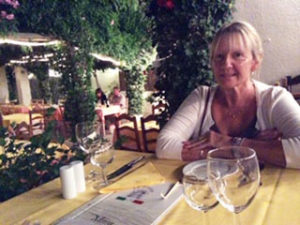
One month pre-synkinesis
I had a series of six appointments with a chiropractor I had been recommended, starting in January 2015 and these really lifted my spirits. There were no promises made of a miraculous recovery or even the ability to help at all but just the feeling that someone understood what was happening to me, made me feel so much more supported. He was mainly trying to help with my jaw which was totally out of alignment. I think the effect of the synkinesis, the tightness in my face, made everything asymmetric. It was really uncomfortable and I couldn’t eat properly. Each time I saw the chiropractor, it improved but it would go back again. He gave me exercises to do every day and I did these – some days better than others! The appointments were very expensive and with the cost of getting there I had to cut them down to every six weeks – but they were a godsend, so we decided they were a good investment for me. I had also been advised to take a number of supplements which I did.
My appointment at my chosen hospital finally came through for the end of January 2015. I saw two people, facial palsy specialists I presume, who asked me to look in the mirror while talking me through some exercises, then I was given a written sheet of exercises to do and was told to make another appointment for six months’ time. In the meantime, I received an appointment to go to see the psychologist there, which I did at the end of March. I remember leaving that appointment in tears. I had talked though all the things I thought were issues for me, such as the feeling of being ugly, the lack of confidence, the feeling that my husband would go off me because I looked so awful, not wanting to go out anywhere and not wanting to be with people, even friends. I left the psychologist’s office after receiving what felt like a lecture on how we don’t always find it easy to admit we are getting older and that my 60th birthday had been a milestone for me that I clearly wasn’t able to adjust to!! She couldn’t have understood me at all and this was all so far from the truth.
By now I had started to think of other ways of helping myself. I started going to acupuncture, which I had never had before. The lady thought she’d be able to help. She wasn’t able to stop or reverse the synkinesis but the acupuncture really helped me understand how my face should feel at rest. I went regularly for six months but it became too expensive and I couldn’t keep this up.
By the end of the summer of 2015 I had asked to be referred to the other hospital my GP had mentioned. My first appointment, and the biggest change to date since getting facial palsy, was in November that year when I first saw a specialist there. It had been 18 months and I hadn’t really felt that anyone fully understood what had happened to me. My visits to this hospital were very frequent at the beginning and I was also able to see a psychologist for eight appointments, which was amazing. She was fantastic. She understood the psychological effect that facial palsy was having. As I’d had facial palsy for 18 months by now, people had stopped asking me how I was, how I felt or even talking about it really. This was good in one way, and I certainly didn’t want to be dwelling on it, but seeing the psychologist gave me an opportunity to talk and examine how it was affecting me. As with any condition that’s long term, there are some good days and some bad in terms of confidence and ability to face the world!

Pre-Botox Sep 2016
The input I got from the second hospital changed everything for me. The therapy I was receiving (a regime of exercises and massage) ensured that I had the ability to help myself daily. I found out so much more about muscles of the face and how they worked, I was linked to a biofeedback machine that showed me how the muscles on one side of my face were working normally and those on my right were five times as active and tight! I elected to have a weight inserted into my eyelid to help it close. (It’s now very hard work to try to enable the eyelid to open as much as I’d like it to) and I also receive Botox injections in my facial muscles every four months. In 2018 I realised that the length of time that my jaw was staying in place was getting longer and longer and I now don’t have a problem with it at all. The chiropractor is certain that his work alongside the support of the Botox injections has made this difference. The jaw certainly weakens when the Botox is wearing off but it hasn’t gone back the way it was.
The support group offered by the hospital is a blessing too. I meet some great people there. We are all very different people and we have many different reasons for having facial palsy – but we have this one thing in common and we feel able to talk about things in a safe, accepting environment.

Feb 2019
Now, nearly five years on I am accepted for who I am and not what I look like by people I know. I can’t say the same about members of the public, or people who may be in a café or restaurant who take an extra long look! But I can block this out most of the time by wearing sunglasses – they give me the confidence to do a lot more than I otherwise would. I am hiding behind them and I know it. But it works for me!!
I still don’t like meeting new people, putting on make-up is a problem, remembering eye drops, massage, exercise – all to be aware of and to attempt to do every day. I’d love to change people’s perception of someone who looks different – I’d love to help people be aware that this can happen to anyone. There’s a lot of work to be done in helping GPs understand the condition and to act early in regard to treatment.
Getting behind the fundraising for Facial Palsy UK and supporting research is crucial. A positive attitude to this massive change in my life is not always easy but it is the way forward.
Disclaimer: Please note that views expressed are person’s own and should not be considered a recommendation of particular medical treatments, therapies or surgeries. We would always advise you seek advice from a health professional with experience in facial palsy who can assess your individual needs.