
Roger describes the difficulties he had trying to access the support and treatment he needed to help with recovery from Bell’s palsy.
After some nervous twitching in my face the night before, I woke on the morning of Saturday 28th December 2012 to find one side of my face had dropped resulting in loss of movement on that side.
On the advice of my family and thinking I was having a stroke I attended the A&E Department at my local hospital. After a full consultation with the doctor and full examination to exclude a stroke, I was told I had Bell’s palsy, a condition I had not heard of before. To my relief I was informed it was a temporary condition that should right itself in about three months or less.

Roger in January 2013
I was told there was no treatment for it other than eye drops to keep the eye moist, damage to the eye being the main fear. The doctor told me there was an option for a course of steroids but her advice was given the possible side effects, I would be better to let things heal on their own. The doctor told me that her father had Bell’s palsy and made a full recovery without the help of steroids. In my state of shock and bewilderment I was happy to take her advice.
I attended the eye clinic a few days later and then saw me GP informing him of my condition. He seemed surprised that I was not given steroids but confirmed that time was the only healer.
Life for me during the first three months of that year was difficult. Teaching in school as I do, even more so, having to explain to all the change in my appearance and the lisp to my voice that had developed. Somehow I kept cheerful and positive and carried on as normal as time off work was not an option I could easily take. The children, parents and colleagues at school together with friends and family at home were kind and understanding which went a long way in helping me live with my Bell’s palsy.
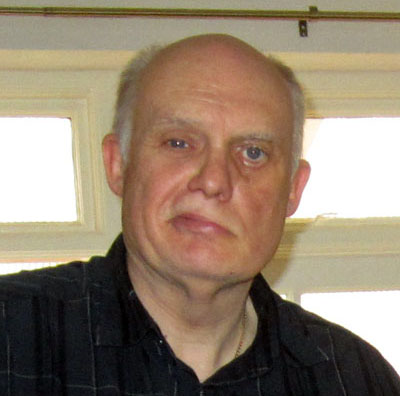
Roger in March 2013
There were many low points during this time such as having to tape my eyelids together to sleep at night and continually having to use eye drops causing a misting up in one eye and a pooling of liquid under the eye. I even had to use an eye patch to hide the affected eye when I was at work. However, I told myself that it was only temporary and tried not to let the condition interfere with my normal lifestyle.
On the advice of a friend I took a course of acupuncture which was twice a week for six weeks. I was told that in many cases this could help Bell’s palsy but by Easter I could see no change, I was disappointed and stopped the treatment. I saw my GP again but he just said that my condition seemed to be taking longer than most to heal and there was nothing more he could offer, this left me with a feeling of helplessness.
By chance, a member of my family saw an article in a TV magazine about Bell’s palsy by a specialist in the condition, and I decided to make an appointment on a private basis to see this consultant.
On Tuesday 7 May 2013, four months after first being diagnosed with Bell’s palsy, I had my first appointment with the specialist. He examined my face and agreed it was taking time to show signs of recovery. He was surprised to find out that steroid treatment was not given; he told me that in many cases this can give you a better chance of recovery but it has to be given within 72 hours of the condition developing, it was too late now. He was also surprised that I hadn’t been given further blood tests or an MRI scan to ensure that nothing else was contributing to my lack of recovery. He then said he would write to my GP so that I could be seen under the NHS, he said he would see me in due course and hoped in the meantime my condition would start to show signs of recovery.

Roger in August 2013
By the summer months of 2013 I am happy to say that my face had begun to recover. I no longer needed to use the eye drops and my face regained much of its normal appearance, I started to feel good about myself again.
Unfortunately there was a delay in my NHS referral being processed due to correspondence required between my GP and the specialist, so it was October before I had my second appointment. By this time my face had gone beyond normal to the point where the affected side of my face was tightening up causing my eye to have a squint. The corner of my mouth had never fully recovered although my speech impediment caused by the condition had improved. My second visit to the specialist was very encouraging and made me feel help was at hand and people were working to give me the best chance of a full or nearly full recovery. I saw a physiotherapist who explained to me that I now had a post Bell’s palsy condition called ‘synkinesis’ which was caused by a miswiring of the nerves as they heal. My nerves had no concept of how to act normally resulting in the tightening of my face and causing a squint in my eye.
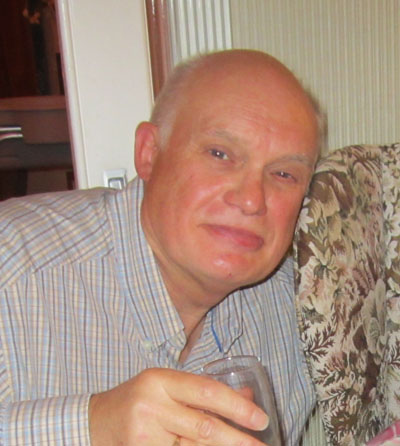
Roger in October 2013
Many tests were done plus photos to record and monitor my condition, and I was given a full programme of facial exercises to carry out to aid recovery from the synkinesis. I was also told that Botox injections would help in my case and this would be carried out during another appointment. Before leaving, a blood test was taken to check for Lyme disease, another possible cause of facial palsy.
In November I once again saw the facial therapy team and this time I saw a psychologist as well who took stock of my overall wellbeing and the effect the experience had had on me. She said I had coped well and did not need to see me again. I was given Botox injections and an appointment was made for an MRI scan in December.
The Botox injections did indeed relieve the synkinesis and my face has now taken on a near normal look. At this time I am left with an eye that does water more than it should from time to time. The corner of my mouth is my main concern as that has still not made too much of a recovery. Other facial features work although one raised eyebrow falls well short of the other. I am continuing with facial exercises and have further appointments with the facial therapy team in 2014.
By way of a final statement and reflecting on changes I may like to see for patients suffering the same ‘Bell’s palsy experience’ as myself. I would like to add the following comments.
Given that in many cases steroid treatment may speed up recovery time from ‘Bell’s Palsy’ I would like to see this given as standard procedure within 72 hours of the condition occurring . I would also like GP’s and NHS hospitals, especially A&E doctors, to have a greater knowledge and awareness of Bell’s palsy and the treatment of it. More needs to be done to highlight the urgency of steroid treatment given the importance of time delay between start of the condition, diagnosis and treatment.
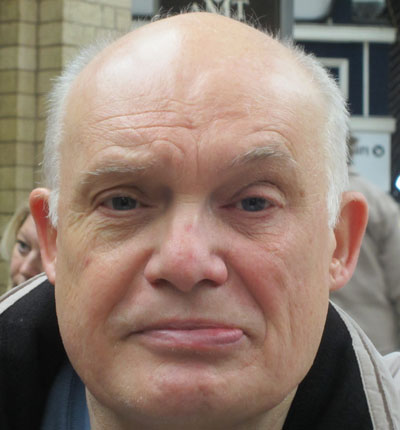
Roger in December 2013
Maybe a leaflet campaign for GP surgeries would increase both clinical and public awareness of Bell’s palsy, including how to recognise the symptoms and explaining how it differs from that of a stroke. This would seem an easy but effective way to put over the Bell’s palsy message, to date I have not seen any such leaflet.
Maybe this leaflet could list centres where Multidisciplinary teams could be contacted. Given my experience, I know the comfort these specialist teams can bring to Bell’s palsy sufferers, the knowledge that someone understands the torment and frustrations they are going through. The reassurance it brings having someone explain exactly what is going on and the treatment of the condition. The great relief it gives being told that in many cases the condition is temporary and a full recovery can be made.
Greater awareness of Bell’s palsy and the treatment of it would be my recommendation in the campaign against this most distressing condition.
Disclaimer: Please note that views expressed are person’s own and should not be considered a recommendation of particular medical treatments, therapies or surgeries. We would always advise you seek advice from a health professional with experience in facial palsy who can assess your individual needs.