
 Trigger Warning: Post-surgery images
There are parts of 2024 that I know only through photographs and the stories my family has told me.
In some of the pictures, I am lying in a hospital bed surrounded by tubes, machines, IVs, and monitors. I look at them now and sometimes have a hard time believing that person is me.
Just weeks earlier, I had been living independently and building my career. I was thirty years old. Brain surgery, facial paralysis, a tracheostomy, a feeding tube, and months of rehabilitation were nowhere in the future I had imagined for myself.
Everything started with symptoms that did not make sense. I was having problems with my balance, dizziness, and difficulty swallowing. On June 29, 2024, I went to the hospital and learned that I had a brain tumour.
At first, all I really knew was that it was benign. I did not know what kind of tumour it was or how large it was. I was trying to process the words “brain tumour” without fully understanding what I was actually facing.
I later learned that it was an acoustic neuroma, also called a vestibular schwannoma. By mid-July, I learned that the tumour was approximately 4.5 centimetres and was compressing my brainstem.
Within weeks, I underwent multiple brain surgeries. What followed was more complicated than I ever could have imagined. I developed aspiration pneumonia and respiratory failure, which caused dangerously low oxygen levels. I needed a tracheostomy to breathe and a feeding tube because I could no longer safely eat. I also experienced infection and sepsis.
When the immediate medical crisis began to pass, I was left facing another reality: the right side of my face was paralysed.
Facial paralysis changed things I had never thought about before. Smiling, blinking, speaking, eating, and expressing emotion were no longer automatic. I also lost the hearing in my right ear. Suddenly, so many of the ways I communicated with the world had changed.
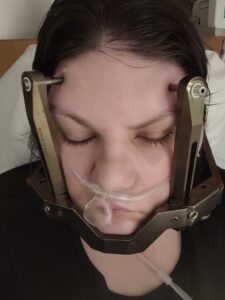
Before this happened, I never realised how much we rely on facial expressions to connect with other people. A smile can tell someone that you are happy to see them. Your face can show amusement, warmth, excitement, sadness, or reassurance without you having to say anything.
When one side of my face stopped moving, I became much more conscious of all of those things.
Looking in the mirror was difficult. Photographs were difficult. I had survived something life threatening, and I was grateful to be alive, but I was also grieving. I was grieving my old face, my independence, my hearing, my career, and the life I thought I would have.
Recovery required me to rebuild basic abilities I had never imagined losing. I had to relearn how to walk and eat. Standing up and taking a few steps could represent weeks of work. Eventually I was able to eat again, my tracheostomy was removed, and after months in hospitals and rehabilitation facilities, I finally returned home in December 2024.
But coming home did not mean that everything went back to normal.
Facial paralysis continued to affect me physically, socially, and emotionally. Meeting new people has become more difficult because I am much more aware of my facial differences and how other people may perceive me. Social situations that once would have felt ordinary can now require much more confidence.
The emotional impact of everything I experienced has also been significant. Since my medical crisis and the changes that followed, I have been diagnosed with major depressive disorder. My depression is part of a much larger experience of surviving a serious medical crisis and adjusting to lasting changes, but facial paralysis has certainly been one part of that adjustment.
One of the most difficult lessons has been realising that surviving and recovering are not the same thing.
In 2025, I began another part of my recovery through facial reanimation surgery. I underwent procedures including nerve grafting and a nerve transfer designed to help restore movement to the right side of my face. I also had an eyelid weight placed to help protect my eye and procedures to improve the position of my eyebrow. Later that year, I underwent the second stage of facial reanimation surgery.
 I have also participated in facial physical therapy.
Nerve recovery is incredibly slow, and learning to wait has been one of the hardest parts. There is no dramatic moment where everything suddenly returns. Instead, progress can happen in tiny changes that someone else might not even notice.
I have learned to notice them.
A little more movement. Better symmetry. Something becoming slightly easier than it was before.
Those changes matter to me.
I am still recovering, and I do not know exactly what my facial movement will ultimately look like. I still experience challenges with my right eye, speech, facial movement, balance, and single-sided deafness. I am still learning how to adapt to a body and a life that changed very quickly.
If I could give advice to someone newly experiencing facial paralysis, I would tell them not to measure their recovery only by whether their face returns to exactly the way it looked before.
It is understandable to grieve. Facial paralysis can affect far more than appearance. It can affect communication, confidence, eating, eye health, relationships, social interactions, and the way you see yourself. Those losses deserve to be acknowledged.
I would also tell people without facial paralysis not to underestimate its emotional impact. Someone’s face is part of how they communicate with the world. A person can be incredibly grateful to have survived an illness or surgery while simultaneously struggling with what that survival has cost them. Both things can be true.
Over time, I began writing about what happened to me. Eventually those words became my memoir, Surviving an Acoustic Neuroma: Facial Paralysis, Recovery, and Relearning Life.
Writing gave me a way to make sense of a period of my life that often felt impossible to understand. More importantly, I wanted someone else facing an acoustic neuroma, facial paralysis, hearing loss, or a long recovery to be able to read my experience and feel less alone.
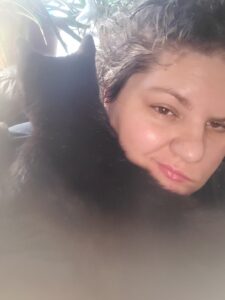 My hope for the future is that I continue gaining movement and independence. I also hope there will be greater understanding of facial paralysis and of the fact that its effects can extend far beyond what another person can see.
When I look at those hospital photographs now, I still feel sadness for the woman in that bed.
But more than anything, I wish I could talk to her.
I would tell her that she is going to make it home.
She is going to eat again. She is going to walk again. She is going to learn how to adapt to things she cannot change. She is going to discover that progress does not always look the way she once imagined it would.
And one day, she is going to take everything that happened to her and put it into words, hoping someone else going through their own recovery might feel a little less alone.
I think she would have needed to hear that.
I know I would have.
Disclaimer: Please note that views expressed are person’s own and should not be considered a recommendation of particular medical treatments, therapies or surgeries. We would always advise you seek advice from a health professional with experience in facial palsy who can assess your individual needs.
Last reviewed: 20-08-2026 || Next review due: 20-08-2029